
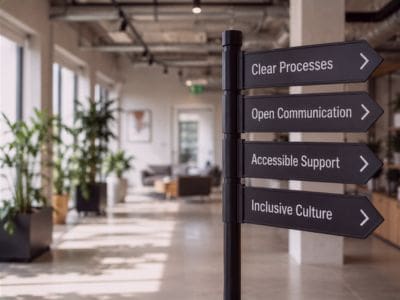


Building a genuinely neuro-inclusive workplace culture – rather than simply having neuro-inclusive policies – is one of the most important and most underestimated challenges in organisational inclusion. Most organisations start in the same place: a policy. Sometimes a training programme. Occasionally a staff network or a neurodiversity awareness week. All of these things have value. None of them, on their own, constitute a culture. The difference between having inclusive policies and being an inclusive organisation is roughly the same as the difference between a code of conduct and people actually behaving with integrity.
This post is about what neuro-inclusive culture actually involves – what it looks and feels like from the inside, and what organisations need to do differently to create it.
What culture actually is
Organisational culture is sometimes defined as “how we do things around here” – the unwritten rules, shared assumptions, and informal norms that govern how people behave, what gets rewarded, what gets ignored, and what feels safe to say or do.
Culture is not what’s written on the wall. It’s what happens when nobody’s watching. It’s whether managers who are told to be flexible actually are, or whether the implicit message is that asking for flexibility will damage your career. It’s whether disclosing a neurodivergent profile feels genuinely safe, or whether it’s technically permitted but professionally risky. It’s whether a team member who works differently from everyone else is described as having “potential” or as being “difficult.”
You can’t create a neuro-inclusive culture by writing it into a policy. You create it through hundreds of small, consistent decisions made by managers, leaders, and colleagues over time.
The gap most organisations are sitting in
Many organisations are currently in what might be called a performative inclusion phase: they are saying the right things, running the right training, and genuinely wanting to do better, but the day-to-day experience of neurodivergent employees hasn’t substantially changed.
The gap tends to show up in a few specific places.
Awareness without competence. Managers have been trained to know that neurodivergent people exist and may need support. They haven’t been equipped with the skills to have honest, specific conversations about what that support looks like for this person in this role. The result is good intentions without effective action.
Policy without psychological safety. An organisation may have a reasonable adjustment policy and a disclosure process. But if the culture signals that disclosing a difficulty is likely to lead to being managed out rather than supported, people won’t use them. Policy only works when people trust it.
Individual adjustment without systemic change. Adjustments for neurodivergent employees are frequently treated as individual accommodations – exceptions to the standard way of doing things. This means they’re dependent on a sympathetic manager, vulnerable to being withdrawn informally, and invisible to anyone who might benefit from them in the future. When adjustments are built into how the team works rather than bolted onto an individual’s file, they become sustainable.
What neuro-inclusive culture actually requires
It requires leaders who model it, not just endorse it. When senior people talk openly about their own struggles with certain kinds of tasks, ask clarifying questions without embarrassment, and name when a process isn’t working rather than pushing through it, they make it safer for everyone else to do the same. Culture flows downward more than any other direction.
It requires clear processes – visible, documented, consistently applied. Ambiguity is disproportionately costly for many neurodivergent people, and it’s also simply bad management practice. When people know what’s expected of them, how decisions are made, and what good performance actually looks like, it reduces anxiety, improves performance, and removes one of the most common sources of friction between neurodivergent employees and their managers. Process clarity isn’t a reasonable adjustment. It’s good design, and it benefits everyone.
It requires genuine psychological safety – not the version that appears in values statements, but the kind where someone can say “I’m finding this hard” without fearing the consequences, where a manager can say “I got that wrong” without it being held against them, and where difference is genuinely welcomed rather than merely tolerated.
It requires feedback loops. Neuro-inclusive culture isn’t a destination. It’s an ongoing process of noticing what’s working, what isn’t, and what needs to change. That means asking neurodivergent employees what their experience actually is – not in a way that places the burden of fixing the culture on the people most affected by it, but in a way that genuinely informs decisions and leads to visible action.
And it requires patience with the pace of change, combined with impatience with stagnation. Culture changes slowly. But it does change, when enough small decisions consistently point in the same direction.
The role of managers
Managers are where culture becomes real or doesn’t. A neuro-inclusive organisation with poor line managers isn’t neuro-inclusive in practice. A manager who is genuinely curious, consistent, honest about what they don’t know, and willing to adapt how they work with different people can make an enormous difference to a neurodivergent employee’s experience – sometimes regardless of what the wider organisational culture looks like.
The most important thing a manager can do isn’t to become an expert in ADHD or any other neurodivergent profile. It’s to ask better questions. Not “what’s wrong with this person?” but “what does this person need in order to do their best work?” Not “why aren’t they managing like everyone else?” but “is the way we’re asking people to work actually the only way it can work?”
Those questions open different conversations. And different conversations produce different outcomes.
What this looks like as a starting point
Building a neuro-inclusive culture doesn’t require overhauling everything at once. It tends to start with a few honest questions.
What does the day-to-day experience of neurodivergent employees in this organisation actually look like? Not what the policy says – what is the lived reality?
Where are the most common points of friction? Is it unclear processes? Inconsistent management? A physical environment that makes concentration difficult? Performance frameworks that measure the wrong things?
What would make the biggest difference with the least disruption – and who needs to be involved in making that happen?
Those questions, taken seriously, are where culture change begins.
If you’d like support thinking through what that looks like in your specific organisation, the NEW E.R.A. Method® provides a practical framework for this work. A free discovery call is the right place to start.
Related posts
What Is Neurodivergent Masking – and What Does It Cost at Work?
ADHD and Reasonable Adjustments: Is the Environment the Real Problem?


