


If you’ve come across the term and wondered what it means in practice, this post breaks it down. The NEW E.R.A. Method® is a three-stage framework for building workplaces that genuinely work for neurodivergent people. It moves beyond compliance checklists and one-size-fits-all policies. Instead, it focuses on understanding how different minds work and what gets in the way. I developed it from professional expertise and lived experience, and it’s designed to be practical rather than theoretical. It works if you’re trying to make sense of your own needs at work. It also works if you’re an organisation ready to go further than surface-level inclusion.
Most organisations I speak to genuinely want to be more neuro-inclusive. That’s not in question.
However, what they don’t always have is a clear picture of what that looks like in practice. They have a policy – often a good one – and they may have run awareness training. They have good intentions and, usually, at least one person who cares deeply about getting this right.
But then a specific situation arises. A manager is supporting a neurodivergent team member and isn’t sure what “good” looks like. An HR professional is trying to put reasonable adjustments in place and doesn’t know where to start. Or a senior leader wants to move beyond compliance and build something that actually sticks – and has no framework for how to do that.
This is the gap the NEW E.R.A. Method® was built to fill.
Where it came from
I didn’t design the NEW E.R.A. Method® from textbook learning. It came from over 25 years of building systems and processes in organisations – working out how things actually function, where the gaps are, and how to make them work consistently for real people rather than hypothetical ones.
It also came from my own experience as a late-diagnosed neurodivergent person who spent most of my career navigating workplaces that weren’t built for how my brain works. I’ve been on both sides of these conversations. I know what it’s like to be the person in the room who is quietly compensating, and I know what it’s like to be the person trying to build systems that work for everyone.
That dual perspective is what the Method is built on. Not awareness alone. Not lived experience alone. But the combination of both, grounded in practical, implementable process.
What NEW E.R.A. stands for
The framework has three stages. For individuals looking to understand how their own brain works and what support would help, Explore is the natural starting point. For organisations, the picture is different. Refine is often the most effective place to begin. This is because making processes clear and visible benefits everyone, not only neurodivergent employees. It also makes something else visible: once the environmental ambiguity has been removed, it becomes much clearer what individual adjustments are still genuinely needed. That’s a more honest foundation for the Adjust stage than starting with assumptions about what a person requires.
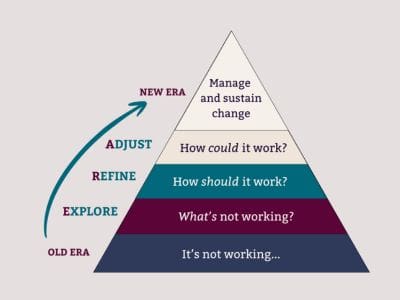
Explore
For individuals, this is the starting point, and the most important one. Before anything can change, you need a genuine understanding of what’s actually happening. Not a generalised picture of ADHD or dyslexia or any other neurodivergent profile, but a real picture of how this particular person’s brain works in the specific context of their role and their organisation.
What does executive function look like for them in practice? Where does friction arise – and is it coming from the person, or from the environment? What are they doing to compensate, and what is that costing them? What would allow them to do their best work?
The Explore stage is where workplace coaching sits. It’s a structured process of understanding before action – because adjustments designed without this foundation tend to be generic, and generic adjustments often don’t help. Where it’s agreed by everyone involved, I’ll work with both the employee and their manager in separate, confidential conversations, so both sides of the relationship are working from the same honest picture.
Refine
For organisations approaching this proactively – rather than in response to a specific situation – Refine is often where the work begins. The process clarity it produces tends to reduce difficulty across the board, including for people who haven’t yet identified as neurodivergent or asked for support.
The Refine stage means making the process explicit – documenting how things are meant to work, who is responsible for what, when things happen, and what “done” actually looks like. Not assumed. Not passed on informally. Written down and accessible to everyone involved.
This matters, because ambiguity is one of the most common and least-recognised sources of difficulty for neurodivergent employees. When a process isn’t clear, people fill the gaps differently. For someone whose brain finds uncertainty difficult, an unclear process doesn’t just cause confusion. It causes genuine anxiety.
Making the process visible removes that uncertainty. It gives everyone – neurodivergent or not – a shared reference point for what’s expected and how things are meant to flow. This is where my background in process design and technical documentation becomes directly relevant: turning informal, inconsistent ways of working into clear, usable systems. Some people can tolerate ambiguity well; others can’t. A clear process costs nothing extra for the people who don’t need it, and makes an enormous difference to those who do.
Adjust
With a clear process in place, the Adjust stage looks at how individual need can be met within it. It’s about identifying where small changes to the process can make a significant difference to a specific person’s experience, without disrupting how things work for everyone else.
Sometimes, this stage reveals that no additional adjustment is needed at all. A clear process alone is enough. When someone understands what they’re supposed to be doing, what order to do it in, and what the outcome should look like, the anxiety and overwhelm that looked like a performance issue can simply resolve. That’s not a workaround – it’s good design.
Where individual adjustments are needed, they’re incorporated into the process itself rather than sitting alongside it as a separate, visible accommodation. This keeps things consistent, reduces the risk of adjustments being quietly withdrawn over time, and means the organisation learns something it can apply again when the next person needs something similar.
The Adjust stage also builds in review – because roles change, teams change, and what works well now may need refining later. That review sits within the process, too, not as an afterthought.
Why this is different from awareness training
Awareness training has real value, and I’d never argue against it. Understanding that neurodivergent people exist, that their brains work differently – and that this difference can look like difficulty in environments not designed for them – is important foundational knowledge.
However, awareness alone doesn’t tell a manager what to do on Tuesday morning when a specific situation arises. It doesn’t produce documented processes that everyone can follow consistently. And it doesn’t create a review mechanism that makes sure things are still working six months later.
The NEW E.R.A. Method® bridges the gap between knowing and doing. It turns awareness into action, and action into documentation that the organisation owns and can build on.
What this looks like in practice
An organisation comes to me with a reactive situation: a capable, experienced employee is struggling. Performance has dropped. Relationships are strained. A manager who genuinely wants to help doesn’t know what to do, and HR is unsure what’s reasonable to ask for or offer.
The Explore stage begins with the employee – understanding how their brain works in this role, what’s creating friction, and what would genuinely help. Where it’s helpful and agreed, I’ll also work with the manager, so both sides have a clear and honest picture.
The Refine stage produces something concrete: documented processes – how work is communicated, how tasks are structured, and how expectations are set and reviewed. Written down. Agreed. Accessible.
The Adjust stage looks at whether anything within those processes needs to shift to meet this person’s specific needs, builds those changes in where they do, and creates a review point so the organisation knows whether things are working.
The outcome isn’t only a supported employee. It’s a clearer, more consistent set of processes that the organisation now owns – ones that are more likely to serve the next neurodivergent employee well, without starting from scratch.
Who this is designed for
The NEW E.R.A. Method® is designed for organisations that want to genuinely build neuro-inclusive workplaces – not those looking for a compliance tick or a training certificate to point to.
It requires honest conversation, some investment of time, and a willingness to look at how the organisation itself contributes to the difficulties neurodivergent employees experience. That’s not always comfortable, but it’s the only way to create something that actually lasts.
If that sounds like the kind of work your organisation is ready for, the full framework is laid out in The NEW E.R.A. Method®: A Practical Framework for Neuro-Inclusive Workplaces – with real examples, tools, and the reasoning behind each stage.
You can find out about all the ways we can work together on my Consultancy page. Or, if you’d prefer to start with a conversation, I offer a free discovery call.
Related Posts
ADHD and Reasonable Adjustments: Is the Environment the Real Problem?
On-the-Job Training and Structure: Why It Matters for Neurodivergent Employees


